




Big questions for 2018
We suspect that the most popular ‘questions’ that people have with regard to the outlook for 2018 revolve around the extent to which the global real economic recovery will continue, and just how many rate hikes the ‘new’ Federal Open Market Committee will need to enact in the USA over the course of 2018. However, and to misquote Donald Rumsfeld, we would suggest that there are always a number of relatively ”known unknowns”, and the outlook for the FOMC surely falls into this category; as such, it is unlikely to trip markets on its own. Instead, we would argue that it is usually the “unknown unknowns that get you”, and we would offer two alternative questions for markets in this respect.
For us, the primary questions for 2018 will be whether global nominal GDP growth will continue to accelerate, and whether this will cause the world’s major central banks to change their policy framework in a relatively fundamental way, away from targeting from asset prices to general (real world) prices. This may seem to represent a technical or even somewhat pedantic point, but we would suggest that two – or even three – modest rate hikes by the Fed, that were still within the context of the current policy regime, would probably not unduly trouble markets, but we suspect that a genuine regime change within central banking would have profound implications for markets, not least since any commitment to raise rates would, in effect, become ‘open-ended’.
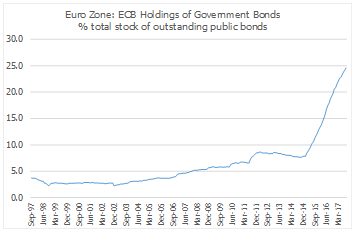
It is of course widely accepted that, since the immediate Post GFC period, central banks have, in general, been either attempting to prevent ‘balance sheet recessions’, or generate wealth effects by pursuing strategies that were explicitly designed to inflate asset values. We firmly believe that these policies, by non-profit-maximizing public-sector institutions, have resulted in the “suspension” or even “subversion” of conventional financial market valuation metrics, such as Price Earnings Ratios and the like. These traditional yardsticks were of course closely watched and influential when the markets were dominated by private sector entities, but more recently, central banks have contaminated the markets and introduced immense moral hazard issues in their efforts to suppress or, in effect, ration volatility. Since these public entities pay little heed to valuations or yields, the markets have been able to follow suit. Nowhere is this situation more obvious than within the bond markets, in which the central banks have not only targeted yields, but contaminated the valuation benchmarks for those markets that ‘price’ off bonds (i.e. which use risk free rates or discount rates…)
Click the button below to subscribe and will have free unlimited access for a limited time to full article and all other articles on the site.
You will also be able to comment on articles on Good Returns.



![[Weekly Wrap] KiwiSaver in play; but outcome unclear](https://goodreturns.publit.io/file/c_fill,w_300,h_200/0ad582e4-c9a3-4692-bbe2-62d928f77fd2.jpg)