


China's Dominant Deficits
Despite the country’s apparent export prowess and its persistent trade surpluses over the last twenty years, we estimate that the Chinese corporate sector is currently running a financial deficit (i.e. the financing gap between in current expenses plus CAPEX and its current revenues) of between US$1.5 and US$2 trillion per annum. This situation is not unique to China – both Japan and Korea’s corporate sectors operated with similar (if not quite so large) deficits during their high-growth phases in the 1960s-70s and 1980s respectively – but as Japan proved in the early 1990s, if and when the necessary financing for these deficits dries up, the results for the domestic economy can be severe. In fact, we further estimate that if China’s corporate deficit were to become unfinanced for whatever reason, then China would in all probability suffer an economic slowdown that would rival the West’s 2008 Great Recession. At the very least, there would be a sharp fall in capital expenditure by companies and also a sharp decline in employment levels and, for this reason, we can reasonably assume that the Chinese government will always attempt to do whatever is necessary in order to ensure that the banking system remains in a position to be able to meet the corporate sector’s funding requirements. China would certainly not wish to see a 1990s-style Japan banking crisis that forced austerity onto its major employers.
In fact, we believe that in order to ensure that the corporate sector’s deficit is funded, along with some degree of property market activity and even a modest amount of consumer credit, it is quite probable that China’s banking system is currently being required to grow its total assets by between $2.5 trillion and $4 trillion per annum, simply to maintain the ‘status quo’ within the economy. Unfortunately, this implies that China’s banking system must continually expand its assets and relative size, despite its already immense existing aggregate balance sheet.
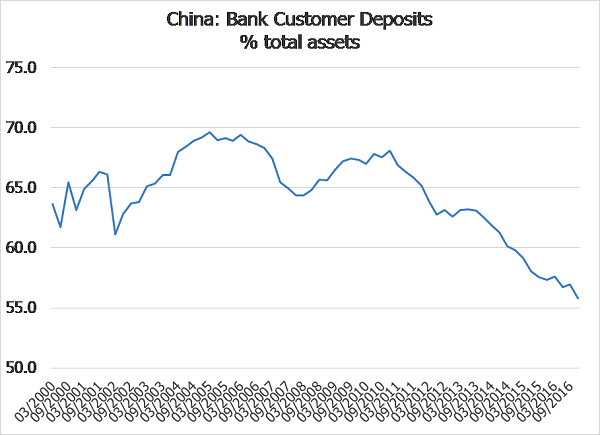
Indeed, according to the IMF’s IFS data, which we suspect is probably too conservative on the subject, China’s banking system possesses total assets that are the equivalent of around 300% of GDP, an already extreme number by any standards (either historical or even regional). Moreover, the IMF also reports that the banking system currently possesses an asset to deposit ratio of circa 2:1, an immensely disturbing situation that has arisen (we believe) simply because of the private sector’s growing levels of satiation with bank deposits as a medium or vehicle for their savings. Having been obliged to save via low-yielding deposits for so long, China’s savers now require something more effective and it is this dynamic that we believe lies behind China’s recent huge capital outflows and sharp equity / commodity / BITCOIN speculation cycles. Certainly, we see these features as being symptoms of this satiation with bank deposits.
Click the button below to subscribe and will have free unlimited access for a limited time to full article and all other articles on the site.
You will also be able to comment on articles on Good Returns.