


Equal weight vs. Market cap weight

Indexing has become mainstream and an increasingly popular way to invest in capital markets. It’s cheap, tax efficient and gives you roughly the same return as the market. Most portfolios track an index that is weighted based on market capitalisation (cap-weighted); individual weights are determined by dividing the company’s market cap by the sum of all constituents’ market caps. There is a growing trend in the academic and investing community that this weighting method could be suboptimal. Could an alternative approach add value to a passive portfolio?
Equal weighting is simple – a portfolio holds the same dollar value in each stock meaning each stock represents an equal value in the portfolio. Each individual stock has the same influence on performance and the results are positive, demonstrated by the graph below. The graph looks at the popular MSCI ACWI Index (orange) compared with the MSCI ACWI Equal Weight Index (blue) over a 20-year time horizon (since inception for the equally weighted index); the equally weighted index outperforms by 2.8% per annum over this period.
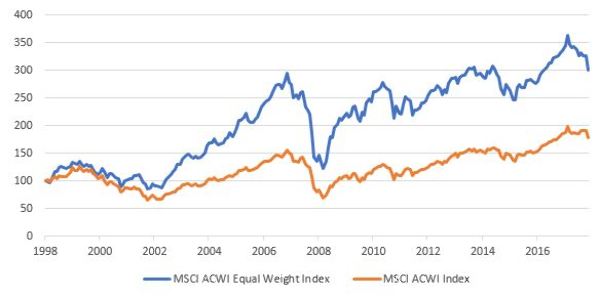
This method of weighting a portfolio has long been studied by academics and practitioners. There is a range of explanations as to why equal weighting adds value over a traditional cap-weighted portfolio. Four key factors are:
Click the button below to subscribe and will have free unlimited access for a limited time to full article and all other articles on the site.
You will also be able to comment on articles on Good Returns.