


Investments
Market Review: The Return Of Volatility
Tuesday 10th of April 2007
|
This market summary is provided by Tyndall Investment Management. To see how the numbers stacked up for various markets around the world in the past month and over the year, visit our Monthly Market Review here |
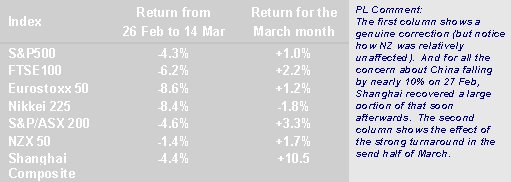 After more than two weeks of such negativity, the markets turned around and produced returns of around 4% for the following week in the US, Europe and Asia. In fact, the US and European rises were the largest weekly rise in four years. The major driver was the US Federal Reserve’s decision to leave interest rates at 5.25%, or more correctly, the driver was the statement accompanying that decision. Markets jumped for joy after the statement made no mention about future rate rises, leading many to believe the bias for the future may in fact be interest rate cuts. By the end of the week, however, re-evaluations of the statement had highlighted comments about inflation risks and the rate cut scenario seemed less likely.
The Fed statement and possible rate cuts also caused the US dollar to fall to a two-year low, which of course meant that the NZ dollar went even higher against it. After a fall below USD0.6800 in early March, the March 8 increase in the Official Cash Rate by our own Reserve Bank saw the NZD embark on yet another rise, breaching USD0.7200 close to the end of the month. The fact the RBNZ raised rates to 7.5% was not unexpected, but you would have to question whether it was the right thing to do, given the signs of a worsening NZ economy and the already very high NZ dollar. Certainly, one feels that the RBNZ needed to act to back up its statements of the past, but the already-struggling export community has just found life even tougher.
So, what of the outlook for the global economy over the rest of the year? The past month may provide some sort of guide. Volatility is likely to remain a factor that will test investors’ nerves at future times. However, despite the volatility that occurred in March, global stockmarket levels are still at either all-time highs, or at least highs since early 2001. Indeed, as we saw in March, the dip in the Chinese market was just a small blip on the continued strong growth path of that market. The massive urbanisation taking place (and is expected to continue taking place for a while yet) in China will cause a huge demand for resources and consumer goods from its citizens. India is another country with a huge potential for urbanisation and demand on a massive scale. At the same time, there are real concerns about the deteriorating housing market and its flow-on effects in the US. So, it may be a case of these emerging Asian economies starting to assert themselves as the drivers of a strong global economy, rather than the US doing the bulk of the work, as has been the case for several years.
There is a possible note of caution, particularly on the US market. During the one year period to 16 Oct 1987 (when the DJIA index rose 22.4%), there were 10 days in which the market fell by 2% or more. In the 18 months to that same date, there were sixteen occurrences of a daily market drop of at least that magnitude (there was only one such example from 24 to 18 months prior to 16 Oct 1987). We all know what happened on Black Monday, 19 Oct 1987. A similarly large number of significant daily DJIA falls occurred in 1928 and 1929 before the large crash in the latter year. After the DJIA suffered no such occurrences at all in 2006, we have now had two 2%+ daily falls in the past five weeks. While it may be spurious to draw any conclusions from this, we will be looking out for such falls over the coming quarter. Maybe the presence or absence will indicate the likelihood of another large market correction.
The key, as always, is diversification (often referred to as “the only free lunch available”). Diversification is important across asset classes, across geographies and within asset classes. The March month provided a clear example of this. Global bonds were strong in the first half (when equities were weak) and both positions were reversed in the second half. If we expect volatility to be increased over the remainder of 2007, a diversified portfolio should at least let investors sleep at night.
Peter Lynn – Interim Managing Director of Tyndall Investment Management
After more than two weeks of such negativity, the markets turned around and produced returns of around 4% for the following week in the US, Europe and Asia. In fact, the US and European rises were the largest weekly rise in four years. The major driver was the US Federal Reserve’s decision to leave interest rates at 5.25%, or more correctly, the driver was the statement accompanying that decision. Markets jumped for joy after the statement made no mention about future rate rises, leading many to believe the bias for the future may in fact be interest rate cuts. By the end of the week, however, re-evaluations of the statement had highlighted comments about inflation risks and the rate cut scenario seemed less likely.
The Fed statement and possible rate cuts also caused the US dollar to fall to a two-year low, which of course meant that the NZ dollar went even higher against it. After a fall below USD0.6800 in early March, the March 8 increase in the Official Cash Rate by our own Reserve Bank saw the NZD embark on yet another rise, breaching USD0.7200 close to the end of the month. The fact the RBNZ raised rates to 7.5% was not unexpected, but you would have to question whether it was the right thing to do, given the signs of a worsening NZ economy and the already very high NZ dollar. Certainly, one feels that the RBNZ needed to act to back up its statements of the past, but the already-struggling export community has just found life even tougher.
So, what of the outlook for the global economy over the rest of the year? The past month may provide some sort of guide. Volatility is likely to remain a factor that will test investors’ nerves at future times. However, despite the volatility that occurred in March, global stockmarket levels are still at either all-time highs, or at least highs since early 2001. Indeed, as we saw in March, the dip in the Chinese market was just a small blip on the continued strong growth path of that market. The massive urbanisation taking place (and is expected to continue taking place for a while yet) in China will cause a huge demand for resources and consumer goods from its citizens. India is another country with a huge potential for urbanisation and demand on a massive scale. At the same time, there are real concerns about the deteriorating housing market and its flow-on effects in the US. So, it may be a case of these emerging Asian economies starting to assert themselves as the drivers of a strong global economy, rather than the US doing the bulk of the work, as has been the case for several years.
There is a possible note of caution, particularly on the US market. During the one year period to 16 Oct 1987 (when the DJIA index rose 22.4%), there were 10 days in which the market fell by 2% or more. In the 18 months to that same date, there were sixteen occurrences of a daily market drop of at least that magnitude (there was only one such example from 24 to 18 months prior to 16 Oct 1987). We all know what happened on Black Monday, 19 Oct 1987. A similarly large number of significant daily DJIA falls occurred in 1928 and 1929 before the large crash in the latter year. After the DJIA suffered no such occurrences at all in 2006, we have now had two 2%+ daily falls in the past five weeks. While it may be spurious to draw any conclusions from this, we will be looking out for such falls over the coming quarter. Maybe the presence or absence will indicate the likelihood of another large market correction.
The key, as always, is diversification (often referred to as “the only free lunch available”). Diversification is important across asset classes, across geographies and within asset classes. The March month provided a clear example of this. Global bonds were strong in the first half (when equities were weak) and both positions were reversed in the second half. If we expect volatility to be increased over the remainder of 2007, a diversified portfolio should at least let investors sleep at night.
Peter Lynn – Interim Managing Director of Tyndall Investment Management
Want to read the full article?
Click the button below to subscribe and will have free unlimited access for a limited time to full article and all other articles on the site.
You will also be able to comment on articles on Good Returns.
Latest News
![[Weekly Wrap] KiwiSaver in play; but outcome unclear](https://goodreturns.publit.io/file/c_fill,w_300,h_200/0ad582e4-c9a3-4692-bbe2-62d928f77fd2.jpg)