


Investments
RBNZ banking rules shaping credit markets

Simon Pannett
Tuesday 5th of February 2019
- A proposed rule forcing banks to hold more equity capital will make the banking sector more stable, however it will come with a raft of second round impacts. Chief among those will be the impact on banks’ willingness to lend. This is what we are watching most closely;
- Separately, we may see explicit preference for depositors over bond-holders in the event of default. If enacted, this may partially offset the credit benefit on senior unsecured paper of higher capital levels; and
- We are also likely to see issuance of a new high-quality mortgage-backed security type.
I. Greater equity shores up banks, but secondary impacts abound
NZ registered banks are currently required to hold equity capital equal to at least 8.5% of their risk-weighted assets. The RBNZ is proposing to increase the required minimum to 16% for large banks and 15% for their smaller counterparts. The proposal will be phased in over five years. The RBNZ is also proposing that the larger banks use more conservative methodology in calculating capital ratios, such that the current stated average tier 1 equity ratio of 13.4% would reduce to 11.6%.
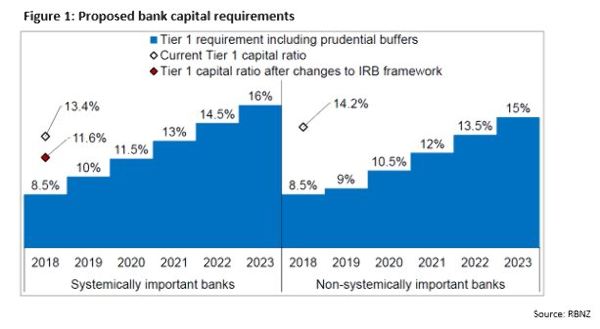
To put those numbers in perspective:
Want to read the full article?
Click the button below to subscribe and will have free unlimited access for a limited time to full article and all other articles on the site.
You will also be able to comment on articles on Good Returns.
Latest News

4 min read


3 min read

3 min read