



The Big Risk: The Creditors' Revolt
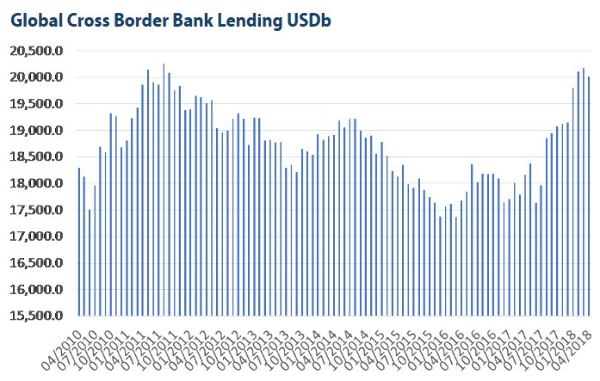
Following the 2008 Global Credit Bust, Bernanke et al simply collapsed interest rates poured excess reserves into their banking systems in the hope that the systems would create more credit. Unfortunately, the ultra-low rates in practice made it very difficult for the banks to grow their earnings in the way that their equity and option stakeholders required, with the result that the banks were obliged to alter their business models; banks in the zero / negative rate economies such as Europe and Japan were obliged either to struggle or to re-invent themselves as international banks, principally by lending dollars (in which interest rates stayed positive) to the emerging markets. Hence, we have witnessed continued slow rates of domestic credit growth in these economies but faster rates of cross-border lending, although truth be told we do not know just how much money has been lent in this way because the speed of financial innovation has overwhelmed the abilities of the statisticians – and more particularly the regulators – to keep up.
Meanwhile, in the USA, the commercial banks have been constrained by the tighter regulatory environment with regard to their conventional lending books and even to an extent with their securities divisions, but they too seem to have been obliged to expand into new areas, principally lending dollars to the aforementioned Euro Zone and Japanese banks. Again, we suspect that the margins have been slim as a result of the Fed’s policy settings but we have a feeling that volumes have been high. In particular, we note how the once ‘boring’ interbank markets have changed from unsecured lending, to repos, to complex derivative structures over the last 10 – 15 years.
Click the button below to subscribe and will have free unlimited access for a limited time to full article and all other articles on the site.
You will also be able to comment on articles on Good Returns.



![[Weekly Wrap] KiwiSaver in play; but outcome unclear](https://goodreturns.publit.io/file/c_fill,w_300,h_200/0ad582e4-c9a3-4692-bbe2-62d928f77fd2.jpg)