


Tyndall Commentary: Why Markets Are Not Reflecting The Economy
In many ways, New Zealand represents a prime example of this: the currency has appreciated by almost 50% since early 2009 but the economy measured in NZD has barely grown over the same period - it is almost as though there is a disconnect forming between the financial and real worlds.
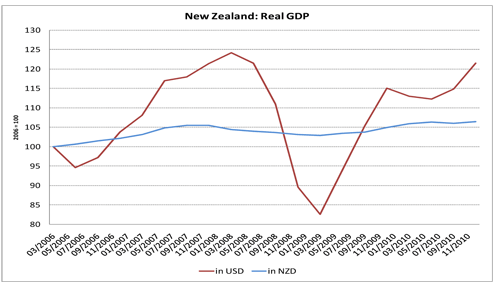 Of course, this disparity in behavior between the real and financial sectors is by no means unique to New Zealand. Clearly, financial markets have generally prospered over the last nine months despite the fact that, in most countries, we are finding signs of a mild stagflation appear as not only reported growth slows but core inflation rates also become notably elevated. In practice, we would argue that these two factors of slowing growth and rising inflation are inexorably intertwined, in that the higher inflation rates are so eroding household real incomes - and in many cases corporate profits as well - that real expenditure growth is falling by the wayside, not that we are that convinced there was much of a recovery in the global economy during 2010 to begin with....
Indeed, it is becoming increasingly apparent that much of last year's economic growth (particularly, but not exclusively, in the West) now appears either simply ‘arithmetic' (i.e. the unwinding of previous intense destocking phases and 2008-9 era production dislocations) or the result of what have already proved to have been unsustainable fiscal policy actions. Consequently, far from appearing ‘V shaped', the global recovery is beginning to look decidedly more ‘L shaped' at this juncture, with last year's ‘highs' now apparently simply the result of specific factors that are no longer with us, such as last year's monster US fiscal transfers to the household sector that implicitly financed much of the US growth in the closing stages of the year. In effect, we are suggesting that it was not the periods of disappointing growth during 2010 that were ‘blips' in an otherwise upward trend but that the periods of strong growth later in the year were in fact upward blips on a much shallower trend.
Click the button below to subscribe and will have free unlimited access for a limited time to full article and all other articles on the site.
You will also be able to comment on articles on Good Returns.