


Tyndall Monthly Commentary: The expectations gap

As is now traditional at this time of year, financial markets are looking forward to some form of global economic recovery unfolding over the next 12 months. Last year, the hypothesised driver for the widely prophesised recovery was expected to be an end to the Euro Crisis – which plainly did not happen – but this year’s catalysts are expected to be a Chinese economic renaissance and the “knock on” effects of the recent revival in the US housing market. Once again, though, global policymakers are much less certain of this benign scenario coming to pass. At the beginning of 2012, we encountered perhaps the widest gap that we had ever uncovered between expectations within financial markets and expectations amongst central bankers and, rather worryingly, this expectations gap does not seem to have closed much with regard to the year ahead. Indeed, many central bankers – including the US’s Mr Bernanke – are still attempting to find new ways to ease their policy regimes and we can only assume that this is because they continue to fear for the global economic outlook.
With regard to possible positive drivers for 2013, it is certainly true that the Chinese central government has launched some form of stimulus package for their economy over recent months. The government’s fiscal deficit has expanded by perhaps the equivalent of 2% of national GDP (a significant but not exceptional amount) and domestic credit growth has picked up. Over the last 3-4 months the Chinese authorities may have added perhaps as much as US$1 trillion of new credit to their $6 trillion economy, a much more significant action.
Unfortunately, it is not clear just how much of this new credit has simply disappeared into the black hole that is the local government financing crisis or into the capitalisation of interest amongst China’s now highly indebted and cash flow constrained mid-sized company sector, but it is nevertheless clear that at least some of the $1 trillion of new credit has found its way into the property markets, albeit through some occasionally rather convoluted channels. The arrival of this new wave of credit has already led to a marked revival in house prices and even a pickup in construction activity but what is also clear from China’s economic data is that the manufacturing sector in general, and exporters in particular, have not been able to benefit from this event.
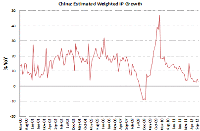
Despite strong rises in the production of cement and other construction-related materials, overall production growth remains very weak. It therefore seems that China’s easing and recovery is confined to a small part of the economy and while this may provide some impetus to the financial markets’ China theme in the near term, in the longer term the world may find itself ultimately underwhelmed by the Chinese “recovery”.
Click the button below to subscribe and will have free unlimited access for a limited time to full article and all other articles on the site.
You will also be able to comment on articles on Good Returns.