


Tyndall Monthly Commentary:Dangerous Assumptions Impact New Zealand

At present, the US and Japanese central banks are involved in massive bond purchase operations which are raising liquidity in both their banking and corporate sectors. Many of the funds that are being generated by these operations are then finding their way out of their respective economies and into the wider global system, with the result that global capital flows are reasonably buoyant at present. We should note however that many of these flows are occurring because the investors concerned are being advised by the investment bank strategists and asset consultants to quit ‘safe bonds’ and instead look for share market and other risk market exposures in advance of an economic recovery. Unfortunately, there is no evidence to support the notion that a global economic recovery is occurring but there is simply an assumption that one will occur before ‘too long’.
New Zealand has of course gained its share – or perhaps even more than its share – of these increased global fund flows. Some of the funds from the US and elsewhere have come directly while others have come by more circuitous routes but, either way, the NZD has appeared remarkably attractive to many investors. This is partly because it is widely assumed by the markets that the RBNZ will be amongst the first central banks to raise what are its already relatively high level of interest rates during any global economic recovery, and also in part because there is an equally widely-held view that the New Zealand economy is already beginning a recovery of its own. Consequently, the NZD has become something of a foreign investor favourite and the exchange rate has generally continued to appreciate as a result.
Admittedly, we are not sure that some of the latest investors into the NZD know what it is that they are actually buying. Indeed, we have heard of one Eastern European central bank that has decided to diversify its own foreign exchange reserves by buying as much as $5 billion of NZD exposure over a relatively short space of time. In per capital terms, this is a frankly absurd level of investment and we can only speculate as to just how fundamentally illiquid this central bank’s position must be, not only in terms of the currency position but also in terms of the NZD-denominated bonds that it has purchased with its dollars. New Zealand’s bond markets are not really deep or liquid enough to facilitate billions of dollars of foreign capital inflow and we must wonder if all of the investors in such assets fully appreciate this fact. But, nevertheless these investors have flocked to the NZD on the assumption that there will be a global recovery and that NZD rates are more likely to rise rather than fall. Unfortunately, we fear that not only have these investors mispriced the ‘liquidity risk that they are taking’ they may also have based their decisions o the wrong assumptions.
Firstly, we can find scant evidence to support the notion of a resurgent global economy. Thus far, Abe-nomics in Japan has failed to generate a revival in economic activity in the economy and there is mounting evidence that Abe-nomics has led Japan’s ever cautious households to save even more and spend less, presumably because they fear rising healthcare costs in the future as a result of the PM’s inflationary policies.
In the USA, the housing market has remained strong but rather inconveniently the strength in the residential property markets has led consumers to divert their all too finite cash resources into housing and away from consumption. Meanwhile, US companies seem so pre-occupied with managing their bond issues and equity buy-backs (which are of course hugely supportive of asset prices in the near term at least) that they are largely failing to invest within the real economy. Hence, far from accelerating, US economic growth trends remain soft.
Meanwhile, in Asia, the higher cost of living that has accompanied the rise in property prices over recent years has resulted in a fall in the amount of income that is effectively available to households to spend in the shops, a situation that has of course not been helped by the weak wage growth that has been itself caused the strength of the Asian currencies and its impact on corporate profits over recent years. Meanwhile, in China and India, rising inflationary pressures are constraining both aggregate growth and the authorities’ ability to support growth.
Finally, in Europe, we find that although the peripheral economies may now be contracting at a slower pace, they are nevertheless still contracting and this economic weakness, together with some of the financial sector ‘fallout’ from Cyprus and elsewhere, is increasingly undermining activity in the once stronger core countries. Hence, we can find little reason to expect a global economic recovery and we certainly do not think that one has already begun despite all that the central banks have done and all the hyperbole offered by many strategists.
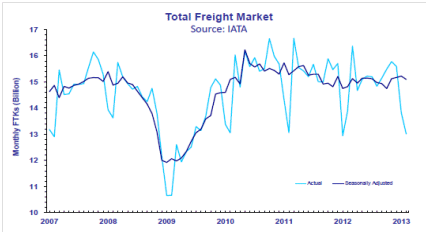
One other piece of important evidence over the state of the global economy at present comes from the physical trade data. According to both the airlines and the shipping company that we have interviewed, there is no sign of an upturn in world trade volumes and apparently little sign that one is around the corner. Therefore, we can only assume that the assumption of a global recovery that has encouraged the latest revival in global capital flows may be an incorrect one.
Click the button below to subscribe and will have free unlimited access for a limited time to full article and all other articles on the site.
You will also be able to comment on articles on Good Returns.