


A focus on sustainable growth and quality
Overall capital market volatility may increase in the near term from low levels as slight increases in inflation rates will allow central banks to unwind low official rates. Capital markets have weathered the transition of the removal of US quantitative easing actions relatively calmly, with European quantitative easing actions providing some offset. At this point in time central bankers are rightly taking a cautious stance in ‘normalising’ official interest rates, with economic data remaining mixed and the revival in inflation not wide spread. But a large amount of monetary stimulus has been removed – meaning even small interest rate changes have the potential to destabilise parts of the capital markets.
The valuation of low volatility, yielding parts of the equity market, that have benefited from fixed interest investors moving up the risk curve over the last three years to enhance their portfolio income yields, are stretched versus historic valuation multiples. The movement into low volatility, yielding equities globally over the last three years has been one of the largest capital market strategy changes seen in recent times. But against yield on fixed interest assets low volatility, yielding equities continue to provide an attractive yield enhancement. These bond proxy sectors may not receive the same degree of investment inflow going forward if fixed interest rates start to creep, even modestly, higher.
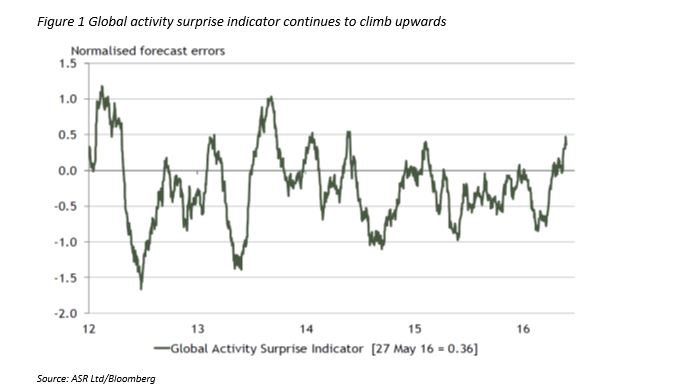
Global economic data remains stronger than many may have expected. As shown in figure 2, global activity surprise indicators produced by Absolute Strategy Research, who provide independent research to Harbour, suggest that global activity may move in to a modestly positive period.
Click the button below to subscribe and will have free unlimited access for a limited time to full article and all other articles on the site.
You will also be able to comment on articles on Good Returns.