




Searching for that right level of diversification
Its long been a topic of discussion by investors, what is the minimum number of holdings required for acceptable diversification in an equity portfolio or an equity fund for that matter. Academics have gone hard at this question with numerous studies seeking to find the perfect number of stocks to hold in a diversified portfolio. In part because the answer can, in theory, be found empirically by crunching the numbers and back testing various hypothetical portfolios. Academics relish serious number crunching, and this topic provides plenty of scope for that. One of the early studies by Fisher and Lorie in 1970 noted that: “the number of possible portfolios containing eight different stocks that could be selected from a list of 1,000 is more than 24 quintillion”. They also noted that “at current (1969) costs for computer time, complete enumeration of all such portfolios of eight stocks would have cost approximately $150 trillion”. As a consequence their study was based on random sampling across the United States share market.
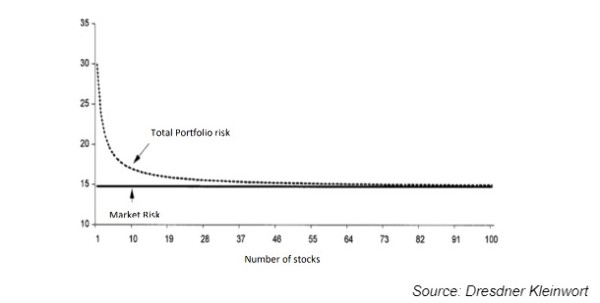
That 1970 study by Fisher and Lorie became a foundation for the notion that 95% of the benefits of diversification are achieved from having 30 stocks in a portfolio. The chart below is a visual representation of that reduction in risk resulting from increasing the number of stocks held. Countless other studies have essentially delivered similar results. This body of academic work means that anyone that has studied finance at college or university has almost certainly been taught that an equity portfolio with less than 30 stocks is too risky.
Chart showing the reduction in standard deviation from increased diversity
Click the button below to subscribe and will have free unlimited access for a limited time to full article and all other articles on the site.
You will also be able to comment on articles on Good Returns.