


The Brook Income Fund
Investing in income funds
Traditionally investors tend to derive income from portfolios primarily made up of cash and fixed interest. But the current outlook for defensive assets is far from compelling. The New Zealand Official Cash Rate is 2.5 per cent and the 10-year government bond yield is currently 3.6 per cent, providing a return barely above the level of inflation. The global situation is even more challenging, with most of the developed world facing negative real interest rates and exceptionally flat yield curves.
In this environment the major dilemma facing investors is how to generate acceptable levels of returns from defensive assets.
Investors want a low risk and reliable income stream, but at the same time need a level of return that maintains the purchasing power of their capital at a minimum.
Growth of income funds
The search for alternative sources of income has led to a rapid increase in the popularity of equity income funds.
This is a global phenomenon and, according to EPFR Global, has been the fastest growing global mutual fund investment theme, with $US80 billion worth of flows seen in the past two years .
The rationale for investing in equity income funds is compelling.
In most developed equity markets, the spread between dividend yields and fixed income or cash yields is close to all-time highs.
This is even more apparent in New Zealand and Australia, as both countries have an imputation credit scheme that avoids the double taxation of dividend income, naturally leading to higher dividend payout ratios.
The composition of both markets is also relatively more heavily weighted towards defensive equities, such as listed property trusts or regulated utilities and ports, which tend to have higher dividend yields.
There is an argument to be made that dividend-paying securities are inherently less volatile.
This is firstly because the types of businesses that have high dividend payout ratios tend to be more mature, with more stable and predictable cash flows.
Secondly, because these companies also tend to have lower growth prospects this means that less of the company’s value is based on long-term growth estimates, which are inherently volatile and difficult to forecast.
But less volatility and low volatility are not the same thing and equity risk does not disappear simply because a company pays a dividend.
The chart below illustrates the relative volatility in returns from equities versus fixed interest and cash in the Australian market.
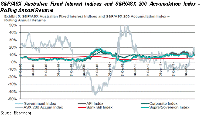
It is also important to differentiate between the volatility of the underlying assets and the volatility of the equity, which can be magnified through the use of leverage.
A classic example of this was the excessive leverage used in the listed property sector in Australia before 2007.
During the Global Financial Crisis the S&P/ASX 200 A-REIT declined by 75 per cent from peak to trough, which was far more severe than the correction in the ASX 200 of 51 per cent.
This is an example of how excess debt can turn low volatility assets into highly volatile equities.
It may be an extreme example, but it highlights an important point - that equity income funds have the potential to be just as volatile as any other equity fund.
This may be even more relevant for the New Zealand market, given the high proportion of defensive assets and the potential overlap in security holdings. The correlation between equity income funds in New Zealand and the equity market is likely to be very high.
Click the button below to subscribe and will have free unlimited access for a limited time to full article and all other articles on the site.
You will also be able to comment on articles on Good Returns.