


When price and value diverge
For our part, we have always favoured Adam Smith’s relatively simple ’value identity’; namely that the ‘value’ of an item should be equal to the weighted sum of its labour, commodity & land, and capital inputs, not least because we believe that it is this simple construct that can explain much of what has happened to the structure of many economies around the world over the last few decades – including New Zealand.
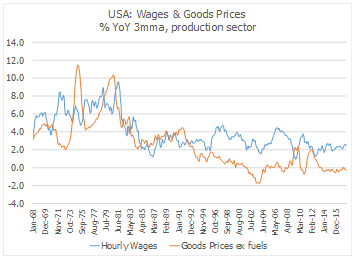
While there has been much talk of the profit share of GDP being high in the USA and elsewhere, the fact remains that within the confines of the goods markets, the rate of average wage inflation has exceeded the rate of output price inflation in the USA, UK and elsewhere quite consistently since the early 1990s. During the 1960s and 1970s, the rate of wage inflation tended to exceed the rate of goods price inflation by a small margin that was closely correlated with the prevailing rate of productivity growth in the sector but since the mid-1990s, the rate of wage inflation has exceeded goods price inflation rates by a considerable margin despite the well-documented declined in average rates of productivity growth. This suggests that corporate margins within the goods-producing parts of the economy have been squeezed by rising unit labour costs.
The situation has been a little different within New Zealand by virtue of the impact of its commodity producing sectors. Here, we find that average wages have risen relative to both service sector prices and goods prices, thereby implying that there has been effective growth in average real wages. However, while we suspect that the increase in wages relative to service sector output prices was more-or-less ‘covered’ by even the modest rate of productivity growth that has been observed in these sectors, we can assume that the increase in manufacturing wages that has occurred since 1996 must have pressured margins within the traded goods sectors.
Click the button below to subscribe and will have free unlimited access for a limited time to full article and all other articles on the site.
You will also be able to comment on articles on Good Returns.