


Equities versus Bonds?
In its weakest form, it is used to describe the difference between the price of a security and an investor's view of the security's intrinsic, or true, value. If the assessment of intrinsic value is made using subjective measures, such as forecasts of the future, then an optimistic enough forecast of the future can give any investment a large margin of safety.
This does not appear to be what Benjamin Graham was meaning. His core premise was that companies should have exhibited enough earnings to ensure that value could still be attained, even in the event of future setbacks. While he didn't rule out using forecasts of the future for a growing company, they need to very conservative forecasts.
Chapter 20 of Graham’s book, Intelligent Investor, is a must read. In it, he provides some simple rules for assessing the margin of safety for bond or equity investments. He also discusses his rules for determining when to invest in equities versus bonds. Graham summaries this in a later lecture that he gave in 1972 where he said, “The margin of safety is the difference between the percentage rate of the earnings on the stock at the price you pay for it and the rate of interest on bonds, and that margin of safety is the difference which would absorb unsatisfactory developments." The percentage rate of earnings on the stock price, or earnings yield, is calculated by dividing a stock's earnings per share by its price. It is, in fact, the inverse of the commonly used Price to Earnings, or PE, ratio.
At the time of the 1965 edition of the Intelligent Investor, the equity market was selling at 11 times earnings, giving about 9% earning yield against 4% on bonds. Graham noted that the earnings yield for an equity portfolio should twice cover the bond interest rate. In the 1972 lecture, he noted that equity prices had risen so high that there was no difference between the earnings yield and the interest rate, and that there was no margin of safety.
So where are we now?
The below chart shows historic bond and earnings yields in the United States. The bars indicate the margin of safety. Bars above the zero-line show times when earnings yields are higher than bond yields and there is a positive margin of safety. Lines below the zero-line show times when bond yields are higher than earnings yields and there is a negative margin of safety.
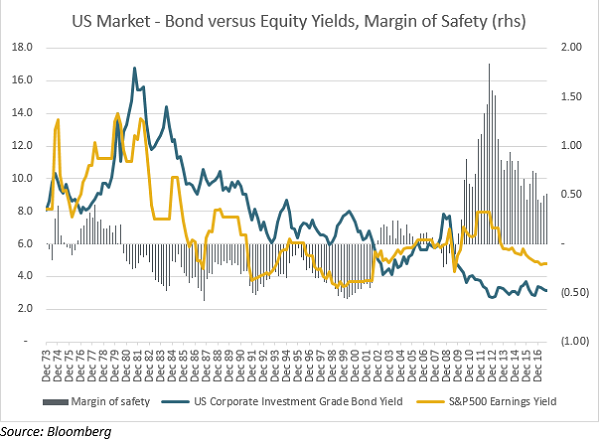
Mr Graham would have waited a long time to get an investable margin of safety for equities. In fact, remarkably, equities have yielded less that bonds for a large portion of time. The current margin of safety doesn’t look too bad compared to history dating back to 1973, but it is still a long way off twice covered, at 0.5x.
Click the button below to subscribe and will have free unlimited access for a limited time to full article and all other articles on the site.
You will also be able to comment on articles on Good Returns.